






A snow-covered small-town street at dusk, lined with illuminated two-story houses and a grain elevator on the horizon.

Mini Split Installation in Wellington, KS

Tell us about the job

Takes about a minute. No obligation.

New system or replacementMini-splitSumner County, KS
Step 1 of 2

What ZIP code is the job in?

Half the homes in Sumner County were built in 1962 or earlier. A house that age wasn't built with a mini split in mind. The walls, the room layout, where the electrical panel sits, all of that came first, and the system has to work around it rather than the other way around. That matters for installation because the line set has to run somewhere, the outdoor unit needs a spot that makes sense, and the electrical has to support what the new system draws. None of that means an older home is a problem. It means the installer needs to look at your house specifically, not just size a unit off a chart.

7 months
October through April, your system heats
5 months
May through September, it cools
25°F
the average winter night it heats against
91°F
the average summer afternoon it cools against
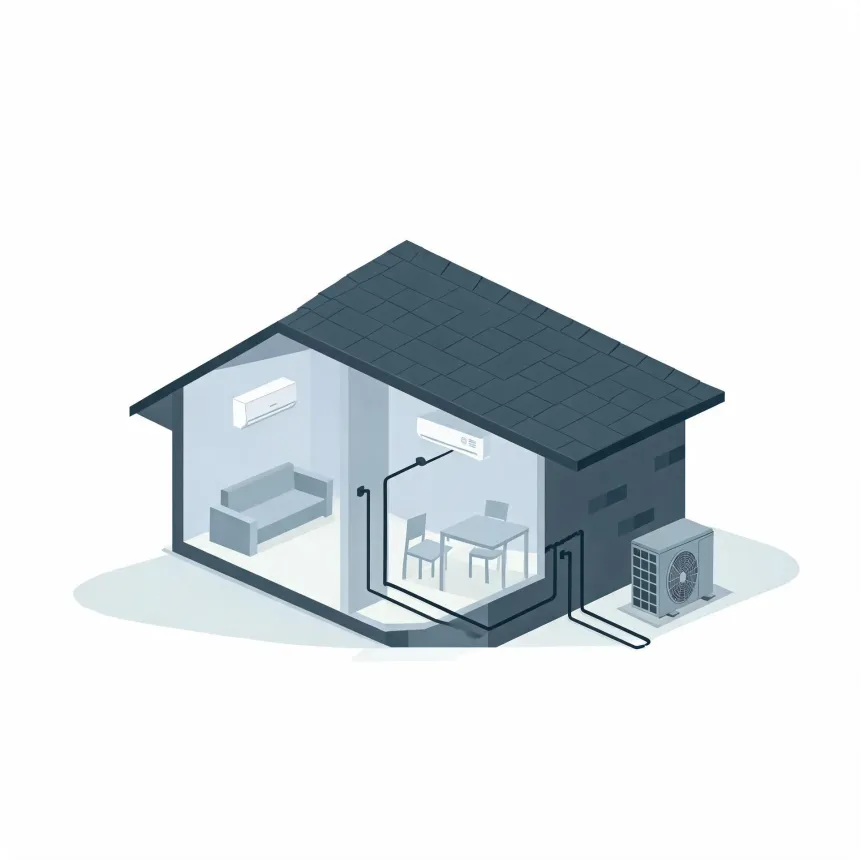
Isometric illustration of a cutaway single-story house showing two wall-mounted mini-split indoor units connected by line sets to an outdoor condenser beside the building, with a sofa, table and chairs inside.
Your system heats October through April and cools May through September.

NOAA nClimDiv, 1991–2020 normals

A mini split here runs cooling five months straight, May through September, with afternoon highs averaging 91°F.

That unit earns its keep every summer, so sizing it to your house matters more than finding the lowest price.

Most of Wellington heats with gas, so a mini split takes on cooling, not the whole job

57.6% of homes heat with gas
Climate zone 4A
Power here costs 14.38 cents per kilowatt-hour
Electricity here costs more, so efficiency mattersHomes in Sumner County paid an average of 14.38 cents per kilowatt-hour in 2025.

Sumner County sits in climate zone 4A, which asks real work of both the furnace and the cooling system. Any mini split manufactured on or after January 1, 2023 has to meet the federal minimum for a split-system heat pump: a SEER2 of at least 14.3 and an HSPF2 of at least 7.5. A mini split counts as a split system under that rule, so it clears the same bar as a ducted heat pump. That rules out the lowest-efficiency units some installers might otherwise offer. The system quoted to you should already meet this standard, not something you have to ask about separately.

Size it for what Wellington summers ask of it

Five months of cooling a year, with afternoon highs averaging 91°F, puts real hours on a mini split. Get the sizing right for your house and the installation right the first time, rather than picking the lowest bid and hoping it keeps up.

Find a contractor
A person in a dark long-sleeve shirt, tan work pants and brown boots carries a worn leather tool bag up wooden porch steps toward a red front door, beside a potted shrub.
A beige split-system air conditioner outdoor condenser unit mounted on metal wall brackets atop a stucco wall.

April is the month to get this done

Cooling starts in May here, which makes April the month to get a new system in. An installer working in April has room to size the unit right and test it before anything is riding on it. Wait until the first hot stretch and that same job gets squeezed in between emergency calls. Winter asks just as much of this machine. Overnight lows average 25°F across December, January and February, and a heat pump has to keep up through all of it. Putting the install in April gives it a full summer and a full winter ahead, on a schedule you picked instead of one a breakdown picked for you.

What SEER2 and HSPF2 actually measure

SEER2 tells you how efficiently the unit cools over a full season, not at one moment. HSPF2 does the same for heating. Neither number tells you how big a unit you need or how it will perform on the hottest afternoon or the coldest night. Two systems with the same rating can still feel different in your house depending on how well the installer sized and set up the system. The rating is a starting point for comparing units, not a guarantee of comfort.
Why the rating still matters for your bill

A higher SEER2 unit moves the same heat using less electricity, and that difference shows up every time the compressor runs. Over a full season of cooling, that adds up to real savings, especially on a unit that runs long hours. The rating also reflects better parts: a more efficient compressor, a better coil, sometimes variable speed instead of single speed. Those parts tend to hold up longer and run quieter too, so the label is telling you about more than just the electric bill.

What drives the price of an install has more to do with the job than the equipment. Where the outdoor unit sits, how far the line set has to run, whether the wall it passes through is easy to open up or not, all of that changes the labor before anyone touches the indoor head. Electrical work adds to it too, since a new system often needs its own dedicated circuit, and running that from the panel can be simple or a real chore depending on the distance and what's in the way. Multi-zone systems cost more to install than single-zone ones because each indoor head needs its own line set and its own mounting work, not because the outdoor unit is more expensive. A straightforward swap where the lines already exist goes faster than a first-time install where everything has to be routed from scratch. None of this shows up on a price sheet for the unit itself, but it's most of what an installer is actually pricing when they give you a number.

So what do you do with a house built in 1962 or before. You ask the installer to walk the actual space before anything gets quoted. Where the outdoor unit sits and where the line set runs isn't a guess, it's a decision someone has to make standing in your house, looking at your walls and your panel. If the electrical hasn't been updated, say so up front, since a new mini split often needs its own circuit and that work depends entirely on what's already there. A good installer asks these questions before they give you a number. If they're sizing it off a chart without seeing the house, that's worth noticing.