













Profile view of a bearded man wearing a black baseball cap and a dark gray t-shirt against a plain white background.

Why your AC keeps tripping the breaker in Kansas

RepairCentral ACKansas
Step 1 of 2

What ZIP code is the job in?

Why does my AC keep tripping the breaker?

You've reset the breaker more than once today, and it trips again as soon as the AC kicks back on. With the kind of sticky summers Kansas gets, a few hours without cooling is enough to make the house miserable, and you want to know if this is something simple or a sign the unit is failing.

Usually a dirty coil, a weak capacitor, or a failing compressor

A breaker trips because the AC is pulling more current than the circuit allows. A dirty condenser coil outside makes the compressor work harder to move heat, and that extra strain shows up as higher amp draw. A capacitor that's wearing out can't give the compressor the jolt it needs to start, so it drags on the circuit instead. Sometimes it's the compressor itself, worn enough that it pulls too much current the moment it starts. In Kansas, where the AC runs hard through long muggy stretches, these parts see more cycles and wear faster than they would somewhere milder. If the breaker trips every time the unit starts, that points to the capacitor or compressor. If it trips after it's been running a while, heat buildup from a dirty coil is more likely.

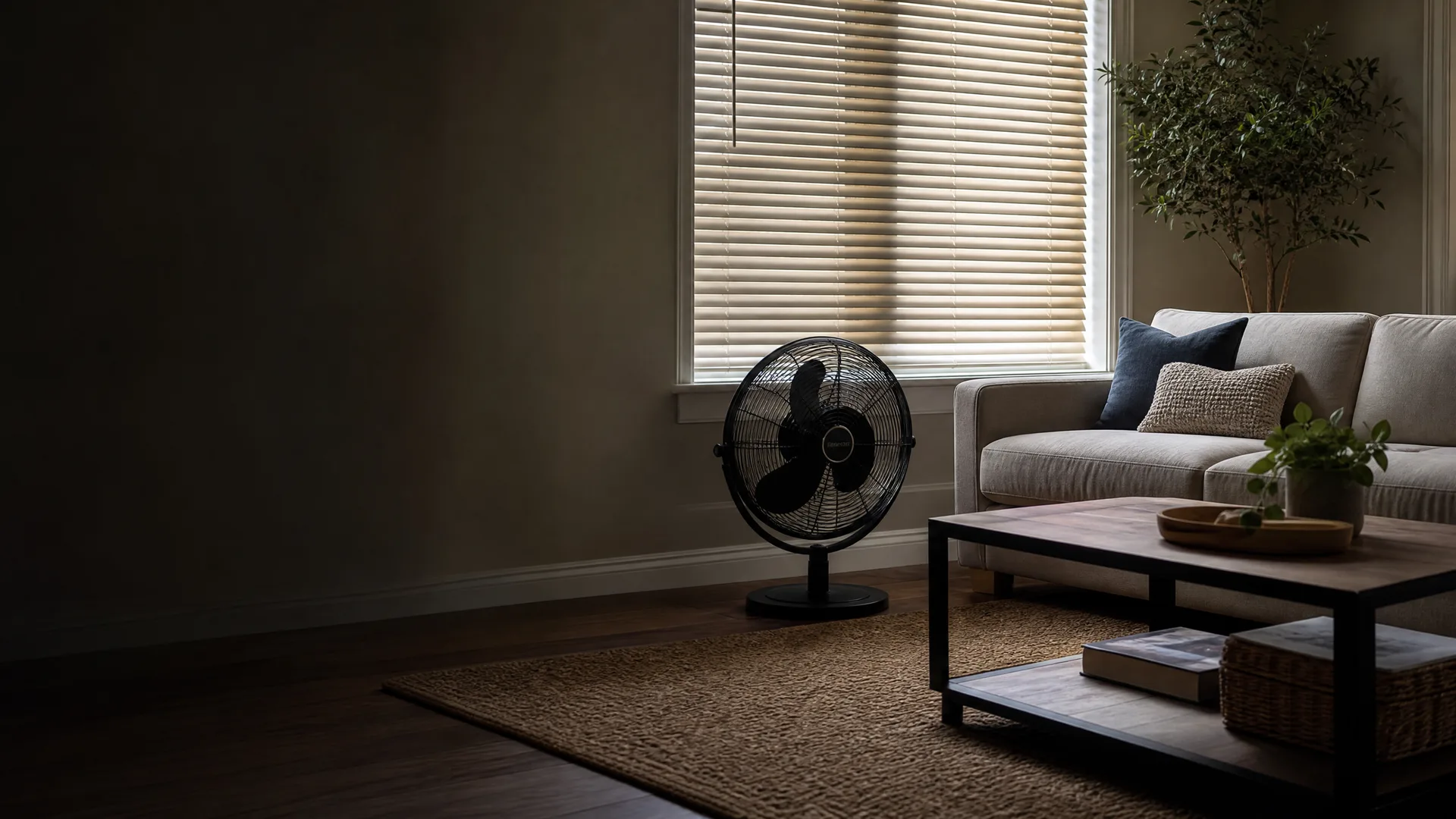
A dimly lit living room with a black table fan on the wood floor near a window with closed blinds, beside a light-colored sofa with cushions, a wooden coffee table, a woven rug, and a potted tree.

It's past three in the afternoon and the sun has had all day to work on the west side of the house. You've got the blinds drawn, but the living room is still warm enough that you pulled the floor fan over next to the couch. It pushes the air around without cooling anything. You can hear the AC trying to start up outside, that hum before the click, and then nothing. The breaker's tripped again. Your kid is sprawled on the rug with a popsicle, trying to stay still so they don't feel the heat as much. You already know you're walking back down to the panel in a minute.

A gray outdoor air conditioning condenser unit on a concrete pad beside a house with horizontal vinyl siding, a brick foundation, downspout, electrical disconnect box, mulch bed and a green shrub.
The condenser outside sits clean, with air moving freely through the fins, so the compressor isn't working harder than it has to.
An outdoor air conditioning condenser unit with a dirty mesh coil guard sits on a concrete pad beside a house with horizontal lap siding, a wall vent, and conduit running to an electrical disconnect box.
Caked dirt on the fins makes the unit pull harder to cool the same house, and that extra draw is what trips the breaker.

What Actually Trips the Breaker

  • A breaker trips when the current draw crosses its rated limit, usually 20 to 30 amps for a central AC circuit.
  • The compressor pulls the most power of any part in the system, especially in the first second it starts.
  • A failing start capacitor makes the compressor motor work harder to start, spiking the draw past what the breaker allows.
  • Low refrigerant forces the compressor to run longer and pull more current trying to reach the setpoint.
  • A dirty or frozen evaporator coil blocks airflow, making the compressor strain against pressure it isn't built to handle.
  • Loose or corroded wiring inside the disconnect box can cause a short, which trips the breaker instantly rather than after it runs a while.

The breaker on your AC circuit is sized for what the system should draw, not what it will draw if something's wrong. Most central AC breakers are rated between 20 and 30 amps, and the compressor is what pushes current closest to that number. It draws the most the instant it starts, when the motor has to overcome standing pressure in the lines before it can even begin moving refrigerant. A healthy start capacitor gets it through that first second quickly. A weak one makes the motor labor through the start, and the draw climbs past what the breaker is built to pass. Low refrigerant causes a different kind of strain. The compressor keeps running, trying to reach the temperature on your thermostat, and the longer it runs under load, the more current it pulls. Airflow problems do something similar from another angle. If the evaporator coil is dirty or has ice on it, the compressor is pushing against pressure it was never built to handle, and it pulls harder trying to compensate. Wiring is a separate issue entirely. A short from loose or corroded connections in the disconnect box doesn't build up slowly like the others. It trips the breaker the moment the circuit closes, often before the compressor even gets going. Which of these is happening in your system determines what gets fixed and how.

Power costs 14.44 cents per kilowatt-hour statewide

At 14.44 cents per kilowatt-hour, a compressor that's drawing extra amps because of a bad capacitor or a dirty condenser shows up fast on your bill. A unit forced to work harder to cool the same house burns more power doing it, breaker trips aside.

EIA-861 2025 statewide residential average

What the compressor draws at startup

Every central AC pulls its heaviest current in the first second the compressor starts, several times what it draws once it's running steady. That surge is normal and the breaker is sized to ride through it. What isn't normal is when the surge runs long or comes in high enough to trip the breaker outright. A weak start capacitor stretches that first second out, so the compressor is pulling startup current for longer than the breaker will tolerate. A dirty condenser adds to it a different way, by making the compressor work against more resistance the whole time it runs, not just at the start.

Why a repeat trip means something specific

A breaker that trips once might just be a loose connection or a fluke. One that trips every time the AC starts, or trips again within minutes of being reset, is responding to a load that's wrong every cycle, not occasionally. That points to the compressor or the parts feeding it rather than the wiring or the breaker itself. Letting it keep tripping and resetting isn't neutral. Each hard start without a working capacitor puts more strain on the compressor windings, and a compressor that fails costs a lot more to replace than the capacitor that was supposed to protect it.

A woman with wavy blonde hair wearing a grey knit cardigan over a green top sits on a sofa in a living room, looking off to the side.
A woman with long brown hair in a cream knit sweater sits on a light sofa in a living room, looking toward a window with sunlight on her face.
A woman in a gray sweater sits in a chair in a living room with a dark sofa, wooden coffee table with a potted plant, and a staircase behind her, looking toward a window.
A smiling woman with dark hair in an updo, wearing a gray ribbed turtleneck sweater, sits on a light sofa in a living room and looks off to the side.

Get your air conditioner to the right pro

A breaker that trips once might be a fluke. One that trips every time the compressor starts is telling you the circuit is seeing more current than it should, and that points to a part in the system, not the breaker itself. Finding out which part means someone checking the capacitor's output, the condenser coil, the compressor's draw against what the nameplate calls for. That's a different visit than a furnace tune-up or a thermostat swap, and not every outfit that answers the phone does it often. Calling around in a Kansas summer with no working AC costs you hours you don't have, and describing the same tripped breaker to three different shops before one can even schedule you doesn't get you any closer to cool air. Handing the problem off once, to a contractor who already knows what a repeat trip on an AC circuit usually means, gets you past that. Your part in it from here is answering when they call.

You can wait it out and keep resetting the breaker, but each restart throws that heavy startup draw at the compressor again, and a trip during the hottest part of the afternoon means the house sits warm until someone's home to flip it back.

Or you get the part that's forcing the extra draw found and fixed, whether that's the capacitor or something else in the circuit, so the AC starts clean and stays on through the rest of a Kansas summer.

An older woman with grey-blonde hair in an updo and a beige turtleneck sweater smiles while looking to the side in a warmly lit kitchen, with a round loaf of bread on the counter in front of her and a dark window showing snow outside.
A woman holds a sleeping boy wrapped in a gray knit blanket on a couch, with a lit table lamp and houseplant blurred in the background.
  1. The compressor draws a heavy surge the instant it starts

  2. That surge passes through the breaker on its way to the unit

  3. A failing capacitor or dirty condenser raises the draw higher

  4. The breaker senses current above its rated limit and trips

A man in a dark polo shirt and cap, seen from behind, walks up a paver path toward a woman standing in the open front doorway of a single-story stucco and stone house.

What a tripped breaker costs you in a Kansas summer

Every reset is a gamble. The AC runs for a while, maybe an hour, maybe the rest of the day, and then trips again right when you've stopped watching it. If it happens while everyone's out of the house, you come home to rooms that have been sitting warm for hours with no one there to catch it. If it happens overnight, you find out at 2 a.m. when the house has already gone sticky.

You don't have to keep guessing whether tonight's the night it holds or figure out on your own whether it's the capacitor, the condenser, or something else pulling too much current. Getting matched with a contractor who knows central AC circuits means someone looks at your actual unit and tells you what's drawing the extra amps, instead of you running down the list yourself one reset at a time.

A living room corner with a light beige sofa holding a textured taupe cushion, a large ceramic vase of olive branches by a window, a framed neutral artwork on the wall, and a dark bowl with stacked books in the foreground.
A two-story house with light horizontal siding, a covered front porch and white door, fronted by a wet concrete walkway, trimmed hedges, a green lawn and leafy trees under a clear sky.

Summer air in Kansas holds a dew point around 64°F, by NOAA's average for June, July and August. That's heavy air, the kind that makes your AC pull double duty, cooling the house and wringing the moisture out of it at the same time. A compressor already strained by a weak capacitor or a dirty condenser has to work harder still to keep up, and that extra load is exactly what pushes the current draw past what the breaker allows. You'll notice it most on the stickiest afternoons, when the unit runs longest and trips are most likely to happen right as the heat peaks.

NASA POWER T2MDEW county cells weighted by homes

What are you noticing around the house right now

You're probably hearing the AC kick on, run for a bit, then go quiet when it shouldn't. Maybe a faint click from the breaker panel before the house goes still again. Rooms that face the afternoon sun stay warm no matter how many times you reset it. If anyone in the house is sensitive to heat, those stretches without cooling matter more than a few degrees on the thermostat suggest. Leave a failing capacitor or a dirty condenser alone and the breaker trips keep coming, each one a chance the house sits warm for however long it takes someone to notice and flip it back.

An outdoor air conditioning condenser unit on a concrete pad beside a house with horizontal lap siding, with a gray electrical disconnect box and conduit on the wall, mulch bed and shrub to the right, and mown grass in the foreground.

Clean and running normal

This is a condenser that isn't fighting anything. The fins are clear, so air pulls straight through the coil and the compressor only draws what it's rated for. A disconnect box like the one on the wall should always be reachable, in case someone needs to cut power fast.

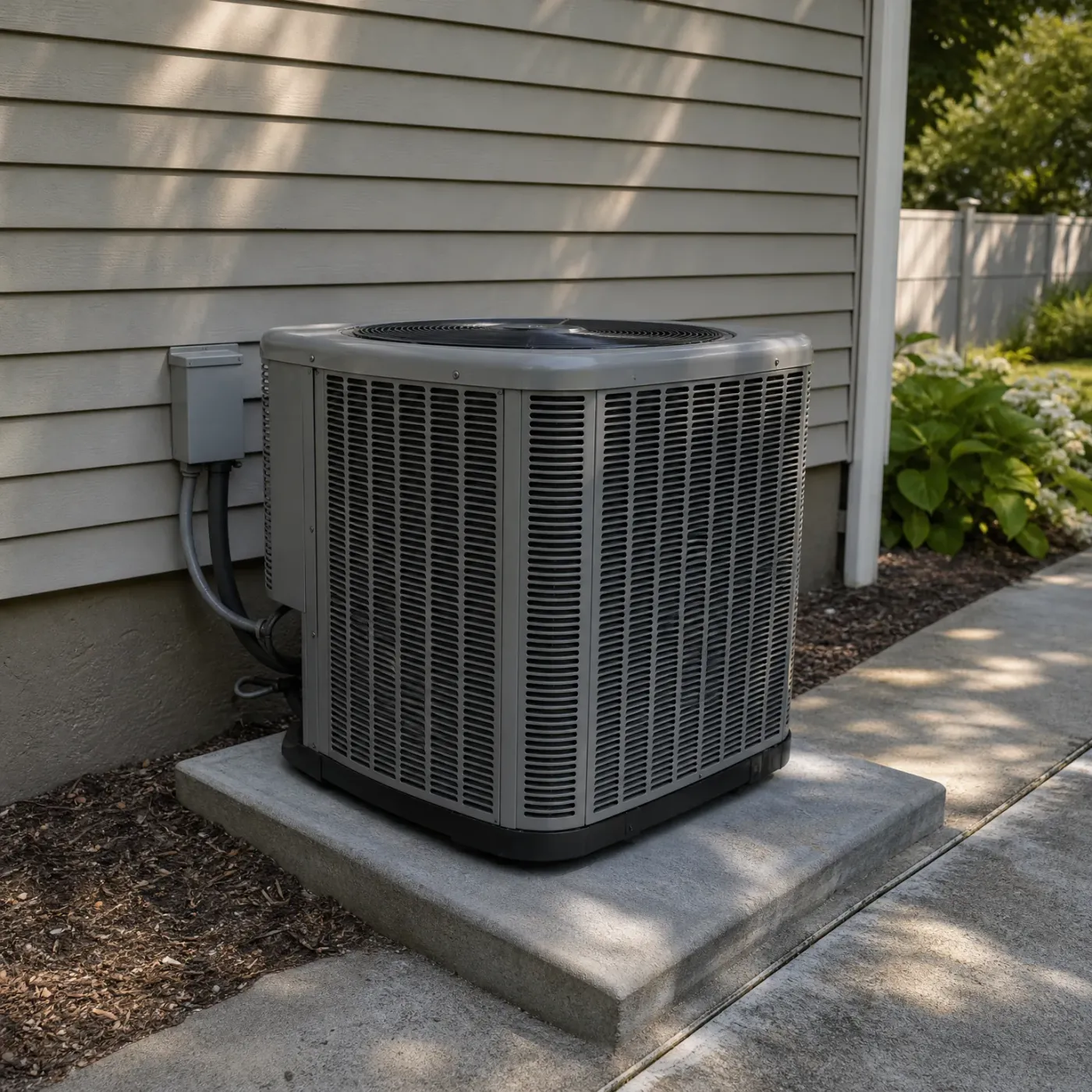
An outdoor air conditioning condenser unit on a concrete pad beside a house with light blue horizontal siding, with a shrub to the left and a conduit and disconnect box on the wall to the right.

Choked and drawing hard

Dust has packed into the coil guards here, thick enough to block airflow through the fins. The compressor behind that coil has to work harder to move the same heat, pulling more current through the conduit and the disconnect box than the breaker is rated to pass.

A breaker that trips every time the compressor starts isn't going to stop on its own. It's a part inside the system pulling more current than it should, and that part has to be found before the house can hold a steady cool again. You could spend the next few days calling contractors, explaining what the AC's been doing, waiting on callbacks, and setting quotes side by side to see who's worth trusting with it. Or you can skip that and get matched with a contractor who takes on jobs like this one, who calls you to talk through what you're seeing and takes it from there. Kansas summers don't let up enough to leave a breaker trip unresolved, and the sooner someone's looked at the capacitor and the condenser, the sooner you stop resetting that panel and start trusting the AC to just run.

A gray outdoor air conditioning condenser unit on a concrete pad beside a house with horizontal vinyl siding, with a wall-mounted disconnect box and conduit, mulch bed, shrubs, and a concrete walkway nearby.

The right pro for this job

Get my match

Fill out one short form instead of calling around.

Sending the form costs nothing.